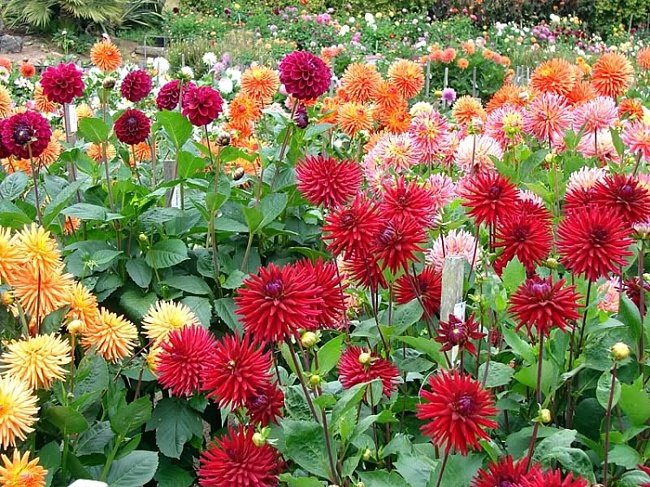
So, we have already considered what kind of flower is a dahlia, how to grow it, what it likes and how to take care of it, but this is not all that a flower lover needs to know about the cultivation of these beautiful flowers. In this article we will reveal the most important topics that may interest you - how to store, multiply and protect dahlias from pests and diseases.
How to store dahlias?
Before the present frosts, the flowers will already bloom, so you should cut all the dahlias shoots in such a way that they leave only 15 centimeters from the root, and then you can dig up the tubers themselves. Well, and shake it off the ground and put it in some kind of winter hibernation tank.
In order to survive in winter, the dahlia tubers could survive, you need to do this: dilute a light solution of potassium permanganate and hold the tubers in it for half an hour, then dry it thoroughly. The first three weeks you need to maintain a temperature of 8-10 degrees of heat, to ventilate the room constantly and to provide air humidity of 90%.
When the first three weeks have passed successfully, the tubers can be sent to the cellar or cellar for hibernation, there the air temperature must be 3-6 degrees Celsius and the humidity 50-60%. Of course, the temperature can vary, but the main thing is not to let the temperature drop below 0 degrees. In the spring, you can find out which sort of dahlia is the best, sort them into different capacities or packages during sorting. Packages should not be covered in any way, so that plants can be inhaled and ventilated. In winter, several times you will have to sort out the planting material, because corrupted and sick tubers may appear.
If you live in a city apartment, then you can store the pigs only if they are dried in a low temperature and high humidity. Place the tubers in a box and send them to the coolest place that only you can have in your apartment. Moreover, you regularly need to look at tubers and remove corrupted specimens. If you notice that the tubers began to dry up, then sprinkle them with water, if from one time they do not get better, then do this procedure a few times.
Reproduction of royal colors
Dahlias can be propagated by cuttings, seeds and vegetatively. April is the most fertile breeding season for this month. In the previous article, we discussed with you how to propagate daisies with the help of seeds, propagation by a vegetative method requires special attention. Before you start to share the tubers, it is necessary that they are a little bit powdered. To do this, they are placed in a box with sand, sawdust or fluorine, instill only 1/3 and put them on a warm light place. The tubers need to be moistened all the time. After you see that they have points of growth, carefully remove them from the ground. Kakuzhe said earlier the tuber needs to be divided so that it would have at least one tuber thickening and part of the root neck with the kidneys.
Next, the separated tubers should be dried and sprinkled with crushed coal, and now it is possible to drop them into pots and boxes. As a matter of fact, as you plant the seedlings in the open ground, it is necessary to keep them indoors at a temperature of 15 degrees Celsius and moderately watered. If you do not have the ability to keep the tubers at this temperature, and they are in a warmer place, then they need to be left in the sunny days to fresh air so that they can be hardened.
When there is no danger of frost, the tubers can be planted on a permanent place in the open land.
If you want to propagate dahlias by cuttings, then you should know that any stalk should be separated from the mother plant with the "heel". The most ideal option is side shoots, which are removed when they reach 8-10 centimeters.
The stem cuttings are cut under the leaf node, the alista can be removed at this time. Immediately after cutting, this stalk is planted in a container, box or just in the ground, but must be covered with polyethylene. The humidity of the air must be high, so that the root system can quickly degenerate. Sam cherenok rooted weeks through 2-3.
Diseases of the Dahlia
Dahlias are very afraid of viral, bacterial and fungal diseases. The most common fungal disease is the black leg, it is very dangerous for young flowers. To reveal it you can see the blackening and thinning of the stem, after that the dahlia dies shortly. In order to prevent this disease, it is necessary to plant cuttings in disinfected ground. If you notice the first symptoms, then immediately the soil needs to be poured with 1% solution of potassium permanganate.
Such diseases as white or dry rot are manifested by yellow, fading leaves. These are fungal diseases. Many flower-lovers, upon detection of this disease, proceed quite radically-remove sick plants, disinfect the earth, and then completely dig it.
Dry rot can overwhelm plants even during hibernation, when you keep only tubers at home. Dry rot on tubers you will notice immediately, so these places are cut to a healthy place, and the cut places are powdered with coal with a gray or gold mixture. And if you see that the tubers are greatly affected, then it is better to throw them whole.
It may be that the dahlias appear on the dahlias, this means that the plant has become infected with powdery mildew. As a rule, powdery mildew develops and appears where very dry air and priperezkih temperature differences. For preventive maintenance use spraying of colors with colloidal sulfur or hammer, which you will dissolve in water, to get 1% solution.
However, you can save the plant at the initial stage of the development of the disease, prepare the copper sulfate with a soapy solution. Take 220 grams of soap, 2 grams of copper vitriol and a liter of water. With this solution, use opsnisteristenie and repeat the procedure in a week.
Viral diseases are much more dangerous and serious, they can be seen in the form of cracks and spots on the leaves, but it is impossible to cure the flower, so sick plants must be removed, and the inventory and all soil should be disinfected. In a few days, without fail, dig well.
Bacterial diseases also disastrously affect the dahlias, they manifest themselves in the form of tuberculate outgrowths that bring flowers to death. Tubers begin to decay, and then decompose, while the surrounding surrounding soil is also infected with bacteria. Nearly five years, these bacteria can be stored in the soil. Plants that are ill with an ailment must be urgently destroyed.
Insects such as thrips, meadow bugs and aphids are also pests and, as soon as possible, are flavored with flowers. Anti-tainting agent - spraying. However, infusion for these purposes should be a special - from Dalmatian chamomile and soap solution. Take 300 grams of soap per liter of water, soap and tobacco solution and other products that very well protect plants from pests. Bugs and slugs can also pozaritsya on young leaves of dahlias. The wireworm will regale the tissues of the tuber plant. The nematode penetrates into the leaves, the roots are exhausted, at the same time there are swellings in those places.
If you saw larvae, beetles or pests in your flower garden, collect them and destroy them, and disinfect the flower bed and garden. Remember that your site should be clean and tidy.
And one more thing: to scare off the pests, use the marigold, which can be planted next to the daisies, then a sharp smell will scare them away.