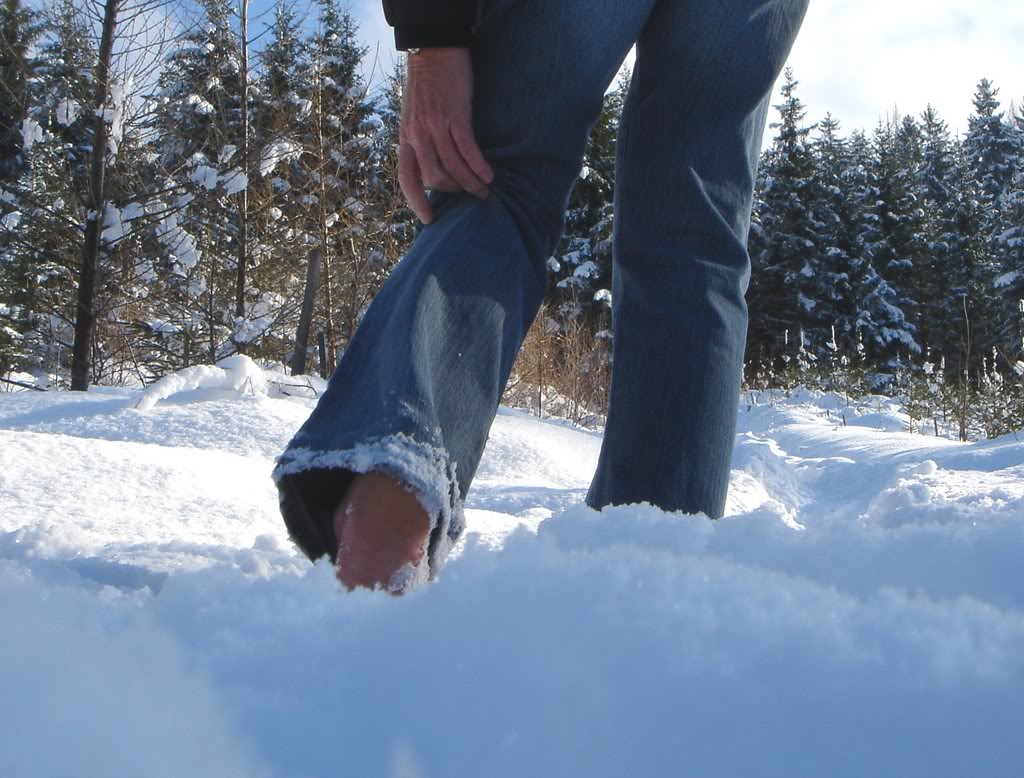
First of all, this technique requires the formation of some psychological attitudes in humans. A conscious attitude to the procedure of tempering and a real interest in achieving a health effect will help to transfer some not very pleasant feelings that will arise at the initial stage of getting used to walking in the snow barefoot. Positive psychological attitude in the implementation of this technique is important almost to the same extent as the physiological state of the organism of a hardened person.
The procedure for walking barefoot should be done systematically and without long breaks throughout the winter period. The need for constant exposure to cold during hardening in this way is due to physiological factors. In the course of scientific research it has been proved that the human body gets used to the effects of cold much more quickly with daily walking on snow for five minutes than with an interval of one day, but for ten minutes. If such health procedures are interrupted for a while, the acquired resistance to cold can be completely lost. In the event that walking barefoot in the snow due to a number of objective reasons is forcibly interrupted for a certain period, it is necessary to resume these hardening measures gradually, starting with light procedures and ending with more effective ones.
At the initial stage of tempering with the help of walking on snow at the onset of the winter period, one should not immediately try to walk barefoot on the snow cover. The first session of such a tempering walk should be preceded by a long preparatory work. In addition to general strengthening and hardening procedures (dousing with cold water, contrast showers, swimming in open reservoirs during the entire summer period), it is necessary to perform exercises, during which cold impact is achieved on the feet. This can be achieved with the help of daily dousing of feet with cold water, and in summer it is desirable to walk barefoot more often (for example, at a dacha or when spending time outdoors in nature).
Walking barefoot on cold snow has a strong stimulating effect on the human nervous system. Therefore, walks on the snow cover should not be too long in time. For this hardening procedure, three to five minutes a day is sufficient. It should also take into account the state of snow. It is best to walk barefoot on fresh, just fallen snow, or on a melting snow cover. It is undesirable to walk barefoot in conditions of very severe frosts or frozen frost, as in these cases it is very easy to injure the skin of your feet with tiny sharp ice. Immediately before the procedure, it is necessary to warm up with vigorous exercises, until the sensation of warmth in the whole body appears. After walking barefoot on freshly fallen snow, it is advisable to rub your feet and perform calf muscles massage to prevent the appearance of seizures from the effects of cold.
There are no specific contraindications to the use of this method of hardening. However, with a strong exposure to colds, more careful attention should be paid to the preparation phase. Directly to the procedure for walking on snow, you can proceed only after full confidence that the body has adequately adapted to the effects of cold when doing exercises on dousing with cold water.