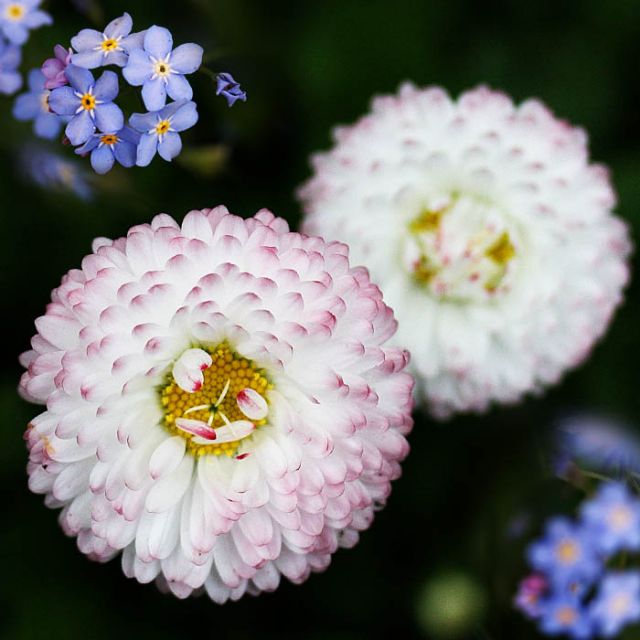
In France, England and other countries on daisies guess. "Daisy, a little flower, red on the edges and with a green border, open the fate of my love ..." - the words of an old French song. In Germany, young girls wondered about daisies about how much they loved their narrowed. After that, the plant received another name - "a measure of love."
At all times daisies have always been a symbol of kindness, cordiality, innocence, true love, purity. In the Middle Ages, daisies were particularly popular. The girls who had not yet accepted the knight's offer gave him a wreath of daisies. King Louis IX ordered to make himself a ring with the image of daisies in honor of his wife Marguerite.
Daisies were sung by poets Shakespeare, Berne, the description of the flower is found in the works of Hugo. Artists painted beautiful flowers on canvases. The most famous painting, where the daisies are imprinted, "Spring" by Botticelli.
Daisies were common in Western Europe, Asia, and the Crimea. From these regions they were gradually brought to England, Australia and to us. The genus of daisies includes 15 species. Flowers are annual, perennial. They have spatulate or shovel-obovate leaves. Inflorescences are small baskets. The plant blooms in April-May. Fruits are small seeds.
In horticulture grow two kinds of daisies. Annual (Bellis annua) and perennial (Bellis perennis). The first are small plants, with white inflorescences. They are used as a pot culture. Perennial daisies have a threefold name - "eternal".
Daisies are divided into several varieties according to the appearance of the inflorescences. Tongue (Bcllis perennis var. Ligunosa hart.) And tubular (Bellis perennis var. Fistulosa hort). Also, plants are distinguished by double, half-marble and non-marble flowers.
The most common and famous varieties of daisies:
Pomponette - a small flower, with "buttons - flowers."
The Pearl is a daisy with white flowers of a small size.
Rob Roy - a tiny daisy with red flowers.
Galaxy Mixed - daisies 10-15 cm high with semi-double inflorescences of pink, red or white.
Habanera - a cultivated daisy with double-flowered inflorescences.
Robella - the inflorescences of this daisy reach a diameter of 5 cm of various delicate flowers.
It is best to feel the daisies in a cool climate, in hot conditions, the flowers quickly lose their mahrovost inflorescence and grow smaller in size. The peak of flowering occurs in the spring. Daisies reproduce by seeds. Sown in June - July in the ground. In 7-10 days there will be shoots. In August, you can transplant to a permanent place, observing the distance between plants at least 20 cm.
The division of daisies can be carried out in the spring, but it is better in August. The selected plants completely cut off the leaves, cut off the roots to 6-9 cm. With a knife, the flower is divided into 2-4 parts and planted in the ground.
Daisies are not fastidious. Grow in any soil. Blossom is better on a sunny place in the soil, rich in humus. In the sandy soil in winter, daisies can freeze, in damp soil - vypret. If there is little snow in the place of growth of the flower, it is necessary to cover the plant with spruce branches. To daisies pleased you with their beautiful flowers they need to weed from the weeds, loosen the soil and water.
Daisies are almost not prone to flower diseases. But sometimes they suffer from viruses. It appears, as a rule, in the beginning of summer. Affected plants must be removed to avoid the spread of the disease. Daisies can rarely be exposed to powdery mildew. Water during the plant, do not zealous with fertilizers to avoid the disease.
In flower beds daisies are perfectly combined with many spring flowers, such as tulips, hyacinths, daffodils, forget-me-nots. With the help of small plants you can create a beautiful flower garden and an original rock garden.
An ancient daisy flower has been pleasing a man for many centuries with its beautiful flowers. No wonder the name of the flower can be translated as "eternal beauty".