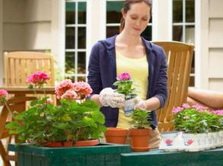
Of course, houseplants are different. Some of them are slightly more complex in content, and some do not require special care at all. If you are new to floriculture, choose species easier. Some of them are of tropical origin (different types of palm trees, philodendron, cacti and others), they need to tinker with a little more to create suitable conditions. Others are not so capricious, it is only necessary to provide them with the necessary amount of water, the right temperature, humidity and lighting level. But do not try to imitate their usual environment completely. Firstly, because it is an expensive "pleasure", and secondly, it will be difficult to support all this constantly. Usually the plants that sell from us have already been adapted to our conditions. At least, it is better to buy those that are propagated from plants grown in our apartments and houses. Find out in advance whether you need to observe special precautions with the plant that you are about to start. There are several types of very beautiful, but poisonous plants. So, if you have small children or pets in your home, you should think about it beforehand. Well, and, of course, when planting a plant in the house, it is good to know at least the main features of its flowering and transplantation.
There are 5 basic elements necessary for growing indoor plants: the amount of water, temperature, humidity, light level and transplant. Do not let the lack of experience deprive you of fresh greenery in the house! Believe me, caring for flowers is not as complicated as it seems. In addition, if you do not have children or pets, growing indoor plants will be the first step towards caring for a living being. So psychologists say - they can be trusted.
Location of indoor plants
The beauty and healthy appearance of indoor plants in the interior are directly related to the amount of light that they receive. There are species that can develop in the dark corners of the room, but there are those that require a constant stream of sunlight, direct rays. And if the location of furniture does not allow you to place indoor plants by the window - do not despair. There are many other ways to place flowers so that they get enough light. Exit the first - hanging baskets. They can be hung on the walls on the sunny side of the apartment - it will be beautiful and original. Only make sure that the baskets have free access so that you can easily water them. Also, do not put household appliances or a TV set under them - water from pots may spill or simply drip on them. The second exit is flower stands, decorative glass shelves and niches. Variants of these things simply do not find - you just need to include the imagination. Shelves are more durable than hanging baskets, but they are more capital. That is, you can not move them from one place to another, if suddenly you want to do a reshuffle in the room. The third exit is the artificial illumination of plants with the help of special lamps, which shine very brightly and are a source of additional heat. They practically replace the sun, and they can be placed in the darkest corners of the room where you would like to make a "green corner". Such spectral fluorescent lamps are installed about 20 cm above plants and provide them with an intermediate amount of light.
Watering and top dressing of indoor plants
Watering is the main factor in the maintenance of indoor plants and usually becomes the most common cause of their death. Sometimes it is difficult to determine the exact amount of water required by the plant, and this leads to one of two results - rotting or drying out of the plant. The first indicator for this problem is the yellowing and defoliation of the leaves. The easiest way to check the moisture level is to simply check the soil for touch. If it is dry at a depth of 0.5 cm, the plant needs water (it may have to start with pouring water into the pan, and only then to water from above). If the soil is too wet - this problem is more serious. Perhaps, the plant will have to be rescued by the method of spilling the roots with dry sand. This is the most common way to protect plants from decay. Although it can not always be saved. Overflow is the most common cause of plant death.
Like any living organism, in addition to water, indoor plants need nutrition. They receive nutrients from the soil (it is better to buy it in specialized stores), additionally introduced fertilizers and minerals that promote growth and flowering. There are fertilizers that are applied with almost every watering (depending on how often the indoor plant is watered) in the form of drops diluted in water. They feed the soil with essential nutrients and support their faster growth.
Humidity and temperature in the room
Most types of indoor plants feel better at temperatures between 15 and 23 degrees Celsius. At a higher temperature, the plants become brittle and weak, and sudden changes in heat and cold generally lead to their death. On the other hand, the lower temperature index will keep the flowers fresh longer and prevent the multiplication of pests in the soil.
It is important that the air in the room is fresh, air conditioners or heating appliances should not be directly directed to houseplants. The room should be ventilated at least once a day (this is useful for the tenants themselves) at any time of the year. The humidity level is a very important factor, especially in the cultivation of tropical representatives, so if there are special heating systems in the humidifier - you need to constantly monitor the humidity level. Another alternative is a gravel site on the soil, which retains moisture longer.
The most common indoor plants
Stindapsus golden is a long creeper with fleshy dark leaves and golden spots on them. For his tendency to curl this type of houseplant is usually grown in hanging pots. He well tolerates bright sunlight, but the rays should not be straight, especially in summer. The plant as a whole is extremely unpretentious. The more it is watered - the faster it grows. Do not worry, if you let it dry, the plant will not die. It has the feature of retaining moisture in the leaves. Therefore, it is better to undercharge it than to pour it. In addition to the standard green species, there is also the Marble (with yellow leaves and white spots) and the Golden Circle (mostly green with a corded off golden thread).
Spathiphyllum - this shade-loving houseplant, a beautiful ornament in the darkest corner of the living room, for example. Beautiful white in combination with dark green leaves give a true charm to the room, where with proper care the plant can reach a height of 120 cm. Specificity of care for spathiphyllum is such that frequent watering is necessary. During the summer months, the plant should be watered every day. It blooms 4-6 times a year.
Ficus is the most common houseplant. Among the many species, ficus rubber, Benjamin ficus, lenticular ficus and Bengali ficus are especially common. Ficuses love light, but well tolerate shady places. They are not fastidious to soils and watering, they are resistant to diseases and parasites. The height of the plant can reach up to 180 cm in height, but you can limit its growth by yourself.
Sansevieria or the ponytail is a common plant in institutions, libraries, kindergartens. Practically does not require care, grows fast and multiplies easily. You can even forget about it for a long time - it will grow and never perish. This plant cleans the air well. It is even able to absorb negative energy coming from a computer or TV. The tailless tail must be in your house.
These are the simplest houseplants, care and reproduction of which you do not have to devote much time. But if you, for example, like exotic species of palm trees, bonsai or rare cacti, do not forget that they are all living organisms, and quite capricious. But even the most simple and unpretentious flowers can also bring you peace and pleasure. Your task is only to grow them with love. And in return you will get amazing beauty, clean air, a healthy microclimate in the apartment.