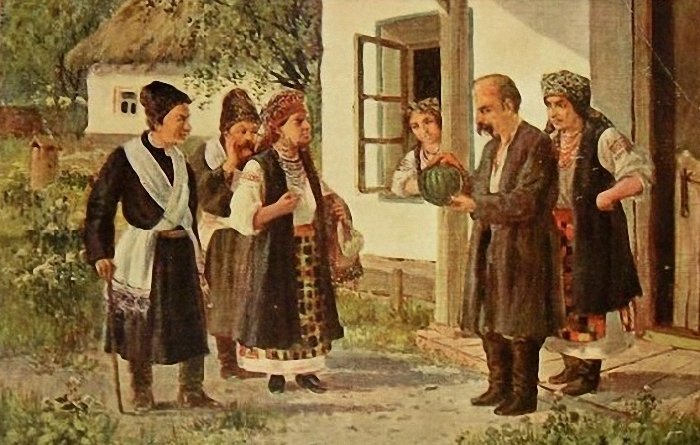
The wedding ceremony has long prescribed the performance of special kinds of activities designed to bring happiness in the married life of the young. And if such actions at the wedding itself can be a huge number, no less important are the traditions preceding the wedding. The celebration of the wedding brings together several generations, joins the families together, and even treated the wedding union with special care. And here there are a number of key moments of the connection of generations - the acquaintance of the groom's parents with the bride, then vice versa, and finally an important moment - the acquaintance of the parents of the bride and groom.
In most cases, the decision about the future wedding was taken by the parents. And, in many cases, it was the acquaintance of the parents of the bride and groom that was key and depended on him whether the consent to the wedding would sound. This rite is called matchmaking and has very interesting traditions in different countries.
In Rus for matchmaking the most successful day was chosen - Pokrov, October 14. At the same time, the suitors wedded together with their parents and other relatives, coming to the bride's house with jokes and jokes. However, the true intent of matchmaking was clear, and the bride's parents in turn answered also cheerfully. From cheerful and allegorical utterances, the phrase "you have a commodity, we have a merchant" is preserved, in this lies the significant role of parents. Sometimes it was necessary to woo two or three times, especially if the bride was known as a beauty, but with a rich dowry. The consent to the wedding was expressed in the joint feast of the parents of both sides. If the bride's parents sent the groom back his wedding loaf - it meant a solid "no."
And if in Rus initiative came from the parents of the groom, in India the tradition differs exactly the opposite - the parents of the bride are wedded. The tradition has survived to this day, and some parents of the bride and in modern India visit the parents of suited suitors, describing the beauty and skills of her daughter and of course her dowry. The acquaintance of the future husband and wife sometimes comes from photographs.
In China, a note was sent to the bride's parents, indicating the name of the groom, the date and time of his birth. Given the importance of the eastern horoscope and its impact on all spheres of Chinese society, this moment was decisive. The bride's family spent fortune-telling about whether the groom and the bride match each other, based on a comparison of their horoscopes. They also guessed at the groom's family. With a positive horoscope, consent was given to the marriage.
At the same time, the parents of the bride and groom got acquainted on the day of signing the young marriage contract. The place of their meeting was the house of the bride, in front of which were placed the figures of animals that give happiness, and before entering the house, deities were worshiped. There was also a joint eating of food, it was supposed to drink a cup of wine - a symbol of the house of the young as a full cup.
However, in some countries, parents could not influence the decision of the young, so, in Polynesia, the guy himself wooed to the girl, coming to her during the dance in battle coloring.
After the consent of the girl, the young ones reported their decision to their parents and if the parents of the bride were against, the young could escape. It can be seen that there is no need to communicate with the parents of the bride and groom, because ultimately the bride's parents have to give their consent to the wedding and hang out a white flag in the form of a white mat-a gift to the bride.
As can be seen from the examples, sometimes the acquaintance of the parents of the groom and the bride is decisive for the wedding as such. And although many traditions are now forgotten, and the acquaintance of parents today is often a formality, it is still very important to correctly acquaint future father-in-law with father-in-law, as well as mother-in-law with mother-in-law.