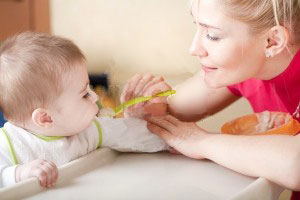
Parents who wish to get acquainted with the scientific base on which recommendations for the introduction of the first complementary feeding to infants are based, we recommend that you carefully read the materials of the World Health Organization and the International Dairy League ("LLL") .The official recommendation is exclusive breastfeeding of the baby for at least 6 months After birth, up to this age, the baby is not offered water, juices, or other foods. 6 months is the lower limit of the beginning of complementary feeding. and later.Necessary addition: under exclusive breastfeeding, WHO implies such principles.
1. A small child receives breast milk as often as he likes. However, the time of each application to the chest is not limited.
2. Nights are mandatory, and if possible, a joint sleep with the mother.
3. During the introduction of the first complementary feeding, the baby is excluded from the use of pacifiers, nipples and bottles.
There is a fairly large group of children who, by the age of 6 months, are not ready to learn anything other than women's milk. This is due primarily to the peculiarities of ripening of the gastrointestinal tract. What kind of kids are often not ready for the introduction of complementary foods by the half-year? These children, who are often sick, are at risk of allergies that have been born by caesarean section (or through other medical intervention), whose motor development is slowing, and who have abnormalities in the development of the nervous system. And also infants, who received in the past, in addition to breast milk, supplementary food, liquids or medicines. But in this there is nothing terrible! You can safely wait for your term, continuing in full breastfeeding and watching the compliance of weight and height of the child with his age standard.
How to properly prepare a baby for the beginning of complementary foods and how to use the introduction of the first complementary feeding to infants?
One of the basic elements of training, as already mentioned, is the presence of breastfeeding. It is in the mother's milk that the substances responsible for the ripening of the enzymatic system of the stomach, the formation of healthy intestinal microflora, the creation of a barrier for the penetration of allergens into the baby's blood, as well as for many other components of readiness are contained.
The next important step to the introduction of the first complementary feeding will be the infant's acquaintance with the life of the kitchen and the behavior at the table. It is the supervision of all manipulations made with food that will allow a small person to form a competent attitude to food. The kid is interested in absolutely everything: where the products are stored, how they look in the raw form, what they are doing with the preparation of the meal, what smells are present, how carefully and harmoniously the meal itself passes. In a word, a new member of the family in all the ways available to him absorbs the culture of attitudes toward food that is characteristic of this family, and also assimilates the basic rules of behavior at the table. Practical advice at this stage:
Allow the baby to be present near you while you are cooking;
more often take it with you to the table during meals.
Babies aged 4-6 months often show a sincere interest in those subjects that they see on the table during breakfast-lunch-dinners. Sometimes this lively interest is taken for a feeling of hunger and, by "regretting" the baby, they begin to introduce complementary foods.The introduction of the first complementary feeding to the baby can not be difficult for the mother, the baby can feel confident.Will not make such a mistake! The baby does not require food at all, but only spoons , plates, napkins and other curious things that lie before him.It wants to imitate the actions of adults: pulls a spoon in his mouth, upsets a cup, brings it to his mouth and chews on a napkin.He wants to thoroughly study the properties of table objects: how they knock, smell, mo but whether to place them on the tongue, he looks closely at the way adults chew and swallow food, reaches out for Mom or Dad in his mouth, tries to repeat such manipulations with food, so we will give the child from the table everything that we consider permissible - those items , which do not harm him and you do not worry about the safety of which.) When the kid bored in your arms, offer him a toy, lower it next to the floor, let him experiment with other objects of kitchen use (pots, ladles, etc.).
Let's sum up what was said and highlight the main tasks of the preparatory stage of getting acquainted with adult food and get acquainted with the introduction of the first complementary feeding to the baby.
1. The kid closely observes the stages of cooking and appearance on the kitchen table.
2. He studies the properties of those objects that are used for food.
3. The crumb gets the first idea about the rules of behavior at the table.
4. Forms a general idea of the person's attitude to food.
I'm ready now?
How to determine that the baby is really ready for the introduction of complementary foods? First group of symptoms
is due to the onset of a certain stage of development of the child's brain. In what way is this manifested?
The crumb reached the necessary level of physical development.
The child can independently grab food by hand, bring it to the mouth, put slices of food in his mouth, chew, swallow or spit out if she does not like it.
Is able to ask for food, show signs of movement, signs or sounds, which of the products he wants now.
Can clearly express the reluctance to stay at the table further.
His extinguishing reflex of language is extinguished: he easily chews on the gums with slices of food, not choking on them and not feeling the urge to vomit. The introduction of the first complementary feeding to the baby is justified by the reflex abilities of the baby.
The appearance of a true food interest in a baby
The interest is precisely for food, and not for items laid out on the table.
The child does not calm down, if instead of eating he is offered to play with tableware, toys, napkins and pans.
The kid is not particularly interested in how adults eat, does not reach for them in the mouth when they chew.
It is unlikely that he will agree to suck breast instead of food.
There is a sustained food interest: this behavior becomes systematic, not one-time. The second group of signs of readiness for the introduction of complementary foods is due to the onset of the necessary stage of ripening of the gastrointestinal tract. What is included in this group?
Absence of allergic reactions after getting to know a new product.
Absence of vomiting after taking "adult" food.
No problems with digestion after samples of unfamiliar food (constipation, diarrhea, swelling).
If there is at least one of these symptoms after the introduction of complementary foods, let's not rush! The gastrointestinal tract of the baby is not yet ready for digestion and assimilation of complementary foods. It is necessary to continue exclusive breastfeeding, wait for the complete disappearance of the unpleasant consequences of the introduction of a new meal and repeat attempts with an interval of not less than one week. That is, the child has sufficient physical maturity, a stable food interest and there are no undesirable reactions from the gastrointestinal tract to complementary feeding. In all other cases, the introduction of adult food will be considered premature.
Important principles for the introduction of the first complementary feeding
The main and most important thing: breastfeeding must certainly remain in the infant's life in the same volume. There is no reason to reduce the number of attachments to the chest.
Introduction of complementary feeding and breast sucking are two parallel processes that perform different tasks and have different purposes. By the way, the baby very clearly shares these functions: for example, to sleep, he still needs a breast, not 50 grams of cottage cheese, and to calm down after the received stress - too.
The second important principle : the lure is built from the products of the mother's diet. It was with them that the baby got acquainted with the time of pregnancy and breastfeeding, they will ensure a smooth and harmless acquaintance with "adult" food.
It is advisable to offer the baby the same food that is being served at the moment to the general table. We hope that your diet is healthy and varied to fit and crumbs. If not, then it's time to make sure that your family menu is more useful: natural products cooked on steamed, boiled or baked; more fruits and vegetables; whole grain, not white bread. Avoid industrial sauces, sausages, sweet pastries, as well as semi-finished products, which you doubt. The third rule: immediately we accustom the child to eat independently. Of course, minimal help is permissible: mother monitors the maintenance of cleanliness around the baby, prompts the right movements, controls his behavior, placing crumbs on his knees. But a child who has fully lived the preparatory period of introduction of complementary foods and began to get acquainted with adult food at a suitable time for him, quite tolerably able to use a cup, spoon, can accurately deliver bits of food to the mouth. The fourth basic principle: the baby is initially offered products of different consistencies. Liquids of different temperatures, softened mashed potatoes, pieces of vegetables or fruits, hard baked goods, crumbly cereals. It is important to teach the baby to fully use the capabilities of the jaw apparatus, as well as to offer incentives for the development of chewing and swallowing skills.
The fifth important principle : the full cycle of complementary feeding is a period of one year.
WHO recommends a rather slow rate of increase in the volume of adult nutrition, emphasizing that up to one and a half years, breast milk should still be the main food of the baby.
When can not you start lure?
Situations when with the introduction of complementary foods should not be rushed, in fact, not so much.
The child is sick with something, undergoes a medical examination, takes medication, or goes to the hospital.
There came a period of active and painful teething. Mom went to work, study, or suddenly fell ill.
The family has just moved to a new place of residence. In the life of the baby there was a nanny or another new member of the family.
The family has a stressful situation: for example, divorce, repair, death of relatives, domestic conflicts. There were dramatic and significant changes in the organization of the baby's life (began to visit the pool, developing classes, went with his mother to the sea, etc.).
To begin with, and the introduction of the first complementary feeding, it is important for the infants to choose the right moment that does not coincide with the above situations. It is advisable to wait until life is right, the baby will adapt to new conditions, his health will be normalized and only after that plan to get acquainted with the new food.