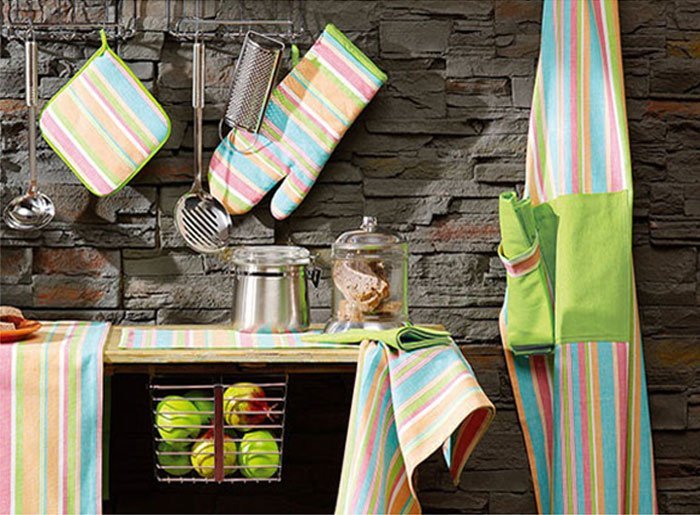
Kitchen - the only room in an apartment or house, which is always associated with various kinds of delicacies, fresh fragrant coffee or beautiful sweet pastries. It is here that you can organize meals with complete comfort. In other words, the kitchen is always associated with satiety. Any housewife, who is important not only to hide her family's hunger, but also the perfect attitude of the spirit of all family members will necessarily acquire textiles for the kitchen of own production or bought with great love. If there is time for needlework, then it is worthwhile to listen to a few tips.
Kitchen textiles and its use
Who does not rank himself as a cronical homosexual, he will quickly list the entire kitchen textiles, which can often be seen. For example, aprons, potholders, tablecloths, towels, caps for tea cups and the most teapot, as well as a different coating for stools and chairs. All this in a complex can consist of a unique atmosphere in the kitchen, and also depend and change depending on the mood of the owners. If the mood is militant and cheerful, then the entrance will surely go bright towels, aprons and potholders of bright colors and fun. But there are days or a situation when you want something quiet or an event that involves rigor and style. That is why it is necessary to acquire several sets of textiles for the kitchen.
The choice of color and form of textile sets should take into account not only personal preferences, but also interior features of the room. For stylish people, compliance with this is fundamental, so nothing should be picked out from the image, and therefore kitchen textiles should be suitable for color, walls or interior decoration. However, contrasts can also be combined, for example, against the background of a blue interior, yellow and red color can be applied, and the restrained kitchen of calm bedding colors will perfectly match the textiles of an orange, pink or green color.
When choosing fabrics, it is desirable to take into account the direction of the interior. If the kitchen is sustained by the "house in the village," linen cloths and ivaphel towels are very appropriate. And if the classical style of dressing prevails, then it is perfectly complemented with cotton products with a monochrome coloring or discreet display of food and cutlery. But the kitchen, designed in the style of hi-tech, rarely gets such luxury as textiles. If he still nasalsya, then this is a maximum of one potholder or apron.
The choice and use of the underwear
To begin with it is necessary to be defined that the category of table linen concerns, and proceeding from enough widely assortment of the subjects representing it, it is necessary to talk about it in more details.
Tablecloth is one of the fundamentally important moments and special subjects, without which the table setting is far from complete. The tablecloths are made from a variety of materials, the most popular of them are linen, cotton and silk, which are solemn in character. Any of the listed tablecloths must match the size of the cover all its sides not less than 30 cm. In some ceremonial occasions for serving, tablecloths are used, the edges of which can reach the floor. Any table cloth on the table should be well ironed.
Before you can put a tablecloth you can use a soft cover (molton) or special covers designed to protect the table of deformations and partially to extinguish the ringing of devices.
When serving, you can use tissue napkins, the long side of which can have a length of 80 to 120 cm. Such napkins most often use restaurants, at home they are not widely used. The color scheme of the napkin should be in harmony with the tablecloth.
But on family tables, wipes from cloth for wiping their lips or protecting their clothes, as well as a plate version, took root. A small fabric napkin should ideally be sewn from the same fabric as the tablecloth, and also harmonize the color of the sneaker. In stores, you can often choose a suitable table set of the beads from the same fabric and the same pattern. His choice is better to stop nalnyanyh products, tk. they are well washed and they do not show spots of different origin.
A folded napkin, located next to the tableware, will give the serving a more solemn and neat appearance.
As a tray, most commonly used rectangular, taking into account the fact that it should be enough to accommodate table utensils and additional free space.
Textiles for kitchen hands
For the craftsmen of needlework to acquire a masterpiece of its own execution will not be difficult. Many achievements in this field take its origin from the manufacture of items for the table linen set. Sewing napkins, towels and tablecloths does not take much time, which can not be said for their decoration by punching, embroidery or other means of drawing a picture. To fulfill certain techniques, you need certain knowledge and skills.
The edges of the tablecloth are often decorated with decorative ribbons or fringes, fringed hand weaving, and also crocheted. Ideas for the embodiment of his skill and special design a lot. Each mistress will choose what she likes.
Sewing potholders also does not represent any complication. If you do not have a ready-made pattern at your fingertips, then you just need to circle your palm, preferably on the cardboard. With this type of tailoring, you need to leave the tolerances, because Pothook is not a glove and not a glove and should be easily removed. Some kind of simple hooks are studied even in school labor lessons, for example, square. For filler of each kind of tack, it is desirable to be batting, in extreme cases, just a thick fabric like corduroy or drape. At the end of sewing, do not forget about the fussy eyelet.
Apron can also be made not only in the original form, but also have luxurious ornaments in the form of inserts from satin, embroidery or edging.
When planning the purchase of kitchen textiles or making it independently, it must be remembered that it must create a certain mood, and thus be a bearer of cheerful colors and fun content. However, you should not get involved only in appearance. Practicality never lagged behind the appearance of any product. This also applies to kitchen textile items. Non-staining patterns, threads, ribbons and well-washed fabrics will be a guarantee of durability and practicality, as well as a guarantee of daily comfort in your kitchen.