The ability of a child to speak correctly is the key to his success not only in learning but also in life. What to do and what not to do so that the child has a full-fledged, literate speech? How to teach a child literacy? The answers to these and other questions you will find in this article. Read, train and learn yourself.
Competent speech is a complex complex of various knowledge, skills and abilities. One of the indicators of language proficiency is the correctness of speech. The child should speak without errors in the sounds, accent and endings of words. In addition, literate speech is impossible without a rich vocabulary and the ability to use intonation. Naturally, abusive words and parasitic words are inadmissible, but knowledge of the basic norms of speech etiquette is a must! And more: it is necessary to teach the child to express his thoughts consistently and coherently, to teach him to correctly build words into a sentence, and sentences to text. Of course, all these indicators are interrelated, and it is impossible to become a truly literate person without developing at least one of them. Now we will understand what are the features and ways of developing a full-fledged speech in the baby.
The world of sounds and words.
First of all, the environment in which the child is located influences the development of the children's language. Of course, the kid takes over everything - both good and bad. That's why even with crumbs you need to speak correctly: call it affectionate words, but do not distort the sound of your native language, do not be lisping! Try to talk as much as possible with the baby, draw his attention to the objects around you, explaining their properties and purpose.
It does not matter that he does not understand much yet, you can be sure that you are doing everything right. And soon your reliable helpers will be books of the age appropriate for the child and audio recordings of literary works performed by professionals - famous actors of theater and cinema. Now let's talk about the child's contacts with other children and outsiders. Unfortunately, communication outside the home often becomes a source of problems. Very often children at the age of four to seven years begin to use abusive words, picking them up in the kindergarten or for a walk. As a rule, this is due to the reluctance to lag behind comrades who have already dared to say "something" and now with might and main show off with their "achievements." And your child, naturally, wants to imitate the more authoritative in the group baby, copying this juicy feature of speech. So what if the child suddenly began to swear like a cabman? In such cases it makes sense to meet with the parents of "authority" and agree to take some measures together. In addition, of course, you need to talk with your child. You can, for example, tell him that for a long time people have decided what words can be expressed, and which ones can not. And who does not observe these rules, the opinions of others may not be taken into account. After all, he does not respect common customs and traditions. Tell him that rude words seriously offend people around him. Explain that adults always have enough words to express their thoughts, and strangers, and even such rude ones, should in no case be used. Rules of etiquette associated with speech, it is better to present the child unobtrusively, but persistently. And, of course, one should not forget about the personal example: moralizing does not help if the house sounds war. Observance of these rules will lead to the formation of the correct speech of the baby and to its harmonious development.
Interest in reading.
Teachers unanimously affirm that children who have fallen in love with reading experience much less problems with literacy in both oral speech and writing. In addition, the speech of the well-read child is less subject to the negative influence of external influences, since he always has an inexhaustible source of new words, phrases, thoughts - his favorite books.
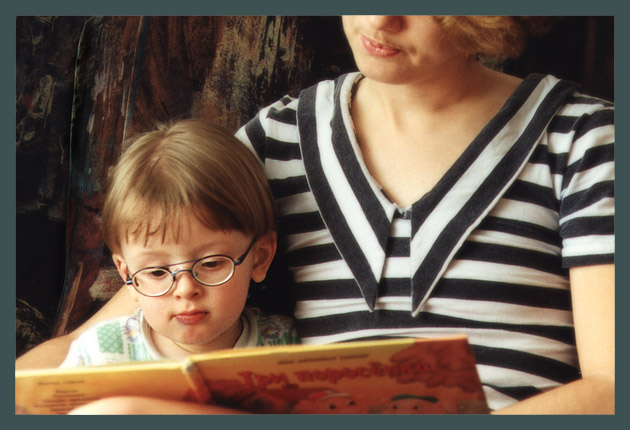
A proven way in developing a child's interest in reading aloud. To familiarize the kid with the book is the duty of caring parents, and there are no age restrictions for starting this acquaintance. No wonder there are books for even the smallest. Just do not forget that you need to read impressively, not hurrying, observing the necessary intonation. In the books for kids, a lot of colorful pictures - look at them together with the child and be sure to comment on them. Do not continue reading if the toddler is tired and begins to be distracted - read only until the kid is really passionate. Joint reading can be rightfully considered a true creative process. But now it's time - your child is now reading on his own ... This hobby, of course, needs to be supported, but it will also have to be controlled. Adults should make sure that the children's library had a wide variety of books. On the first holes this is most likely to be time-tested tales of the peoples of the world, stories and poems of domestic and foreign authors. But it would be good to fill up the bookshelf of the kid with such publications as illustrated children's encyclopedias and reference books where you and your child can always find the answer to any question. With such publications it is worth starting to introduce the child before the school, they will certainly help him in his studies. Almost all children like to study ancient myths and legends - besides these books are often illustrated by famous artists. Books should be accessible to the child, but to teach him treats them carefully is your task. Try to discuss with the child read. Ask him questions, you can even pretend that something is misunderstood. This, on the one hand, is very useful for the development of oral speech, on the other hand it gives good material for conversations with the baby on everyday topics. So you will gradually be able to teach the child to independently learn from the reading.
Often children are addicted to comic books. By themselves, comic books are not dangerous, but you need to watch, so that not only they make up the circle of reading a child. And, of course, be sure to leaf through the pages: the pictures themselves and their captions must be qualitative, interesting, not containing rudeness and primitive. Of course, reading provides the child with a wide vocabulary, but not only. To make this lesson contribute to the development of clarity of your child's speech, draw his attention to the composition side of the text. Try to look at your favorite book from the other side: explain that a story or a poem always has a name and (what is important to pay special attention to) they have the author - the person who wrote it. Why did the author choose this name? What did he mean by that? Explain that any work consists of several parts. At the very beginning the author shows us the heroes, explains what will be discussed. Then he tells the story itself, which, in turn, necessarily has a conclusion. Can, for example, a fairy tale consist only of beginning and end or only from the middle? Proposals in the text can consist of one word, and may take more than one line. Why? For such conversations, you do not need to be a philologist at all, just love the book and patiently deal with your child.
Parental universities.
If you feel the child's sincere interest in the mother tongue, use the recommendations for playing games and exercises to develop his eloquence. Such lessons are very useful!
Classification. Assignments can be different: "Call in one word" (blue crayfish, sparrow, pigeon-fetuses) or "Exclude superfluous" (cyan, sparrow, hare). It is good to use drawings for such a game.
Word processing. You call the word, and the kid has to say how this object will be called if it becomes big or small. For example: ball-ball-ball.
Synonyms, antonyms. A child in your sample selects suitable or
opposite in meaning of the word to the given.
Riddles, crossword puzzles. The child unravels the ready-made crossword puzzles appropriate to his age, or you can create for him an amusing crossword puzzle, for example, with the names of his favorite fairy-tale heroes.
Puzzles. Kid guesses puzzles and tries by analogy to come up with riddles on his own.
By the principle of the game "to the city". Each participant calls a word that starts on the last letter of the previous one, spreading it to any objects: flowers, names, names of animals, household items, etc.
Read analysis. With older kids who are already preparing to go to school, you can try to do something like "parsing the poem." You draw his attention to the expressive means of language, for example, epithets (special, beautiful definitions), comparisons, refrains, explain what rhymes are.