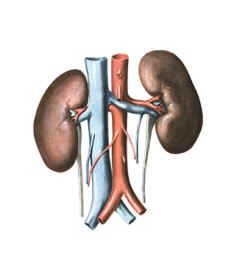
When the roots are irritated, a protective reaction takes place: the intervertebral muscles are disengaged, which, as it were, stretch the vertebrae, and due to this, the lymph enters the discs, and the overlying muscles turn on all the depth and pull down the whole corset surrounding the spine. What to do with kidney pain, find out in the article on "What to do with acute pain in the kidneys."
At the same time, the blood vessels that bear blood to the roots, spinal cord and vertebrae are squeezed. The spinal cord, ganglia, and intervertebral roots begin to suffer. This prolonged muscle spasm results in squeezing the capillaries. They stop receiving fresh blood, and, consequently, oxygen. It turns out that the muscle gets only lymph (it turns into scar tissue, because the lymph vessels germinate very actively and quickly), and only it feeds these tissues. This, of course, is a protective, saving reaction. If it was not, then there would be necrosis - the death of this muscle. But there is little oxygen in the lymph, the muscle is depleted, resulting in microspikes, and then scar tissue. Thus, dense fibrous-adhesive conglomerates are formed along the spinal cord, which cause painful radicular sensations - radicular syndromes. They can be local or spread throughout the spine. The pain in this case can begin with the middle thoracic spine (probably because the muscular corset there is most developed) and reach the coccyx. These strong pains tighten the spine, rootlets, twist the person. On the basis of these changes, torsion syndrome develops in the future - as a result of irritation of the roots and disturbances in the conductors of the spinal cord along the whole spine, the body begins to twist all the muscles and the person can not even walk.
Since we are talking about colds, I should note that everything I mentioned above is often caused by an infectious lesion of the intervertebral roots. When a fibrous-adhesive process occurs around them (first microspike, then macroscapic), fibrous-cicatricial changes, then there is such a clinic: local pain in the kidney area and below them. The earlier we remove the pain syndrome, the less complications, including the severe secondary ones, when the kidneys begin to suffer, because as a result of the squeezing of the roots, their innervation and nutrition are violated. And since the vessels, of which the renal glomerulus is composed, are reflexively affected, then he too is affected. There is glomerulonephritis, which today is considered one of the most serious and dangerous diseases of the kidneys. Why this disease can arise precisely against the background of an acute cold? Because the infection, infiltrated into the body as a result of acute colds, begins to freely "walk" through the blood, affecting blood vessels and tissues. As a result, glomerulonephritis develops against the background of radicular syndrome. If there is no radicular syndrome, the innervation and nutrition of the kidneys, as well as the kidney glomeruli, are not violated, and no flu, no infection to the kidneys will get. They are affected already when there are complications of acute colds in the form of violation of innervation, inflammation of small vessels of the kidney. If an infection is added, we get glomerulonephritis or pyelonephritis.
I must say that pyelonephritis is treated quite easily - it is enough to drink decoctions of herbs (yarrow, "bear's ears" and others). But if we want to not only remove the syndrome, but also cure the disease, we must necessarily combine the neurological, vascular, muscular and renal components of treatment. In addition, it is necessary to apply heat and special gymnastics. Such an integrated approach allows you to quickly stop the process of damage to the kidneys and ganglia. The most interesting: as soon as the clone-cell of some internal organ receives normal electrical impulses and normal nutrition, the organ is restored - it regenerates healthy cells. Therefore, it is important to be able to work correctly with those places where there are near-invertebrate fibrous-adhesive conglomerates. It is necessary to achieve that the muscle becomes soft, so that it relaxes; that it, as it should be, strained (thus all stagnant phenomena are removed); so that when it is squeezed there are no painful seals or, vice versa, pits, which indicates the atrophy of the muscle tissue and the destruction of it as a result of eating disorders. And since our organs have such a wonderful ability to recover due to the activation of the clone-cell, then during normalization of its vital activity it begins to normally reproduce and produce healthy cells of the organ.
So, dear readers, you must clearly understand how glomerulonephritis develops and why the kidneys are aching (this happens in the most neglected cases, because the kidney is very well organized). In addition, the parenchymal organs, which include the kidneys, liver, pancreas, do not hurt themselves - the capsule hurts, which swells and increases. In it are painful vegetative endings, so there are unpleasant aching pains. Understanding how the process proceeds allows not only correctly treating catarrhal diseases with complications, but also quickly relieving the patient of pyelonephritis and even glomerulonephritis if treatment has not previously applied hormones. Hormones, acting through the hypothalamus, deprive the body of the ability to self-regulation. So, the appearance on the background of a cold of pain in the kidneys or in the kidneys - a serious symptom, which must immediately respond.
Treatment:
1. Implementation of all procedures recommended for the treatment of acute colds.
2. Correction of electric current through the intervertebral ganglia, intervertebral roots, which leave the segments of the spinal cord innervating this organ.
3. Correction of all parts of the spine in order that the impulse, which we activate from any part of the spinal cord, could equally and smoothly go up and carry information. In order for this to happen, the voltage, current, electric and magnetic field throughout the spinal cord must be working, and the flow of electric current should not be disturbed anywhere. Modern man often suffers from the cervical department, so when working with local systems of innervation, it is necessary to take into account the state of this department.
4. Vascular correction - pressotherapy. Pressing with special techniques on the kidney area on the side and back. In the hypochondrium from each side, we squeeze the kidney on exhalation, squeezing out the liquid from it. Thus, we pump the kidney tubules, fresh oxygenated blood is pumped in there, and the kidneys begin to recover.
5. Biochemical correction. For her, as a rule, hepatic-renal collections of wild herbs are used, because if the kidneys are damaged, the liver suffers, liver-kidney failure occurs.
6. Warming in different ways of the area of the paravertebral roots (not on the spinal column!) And the kidney area - rear, side and front. The bath acts as a local (on the skin receptors, deduced for innervation and regulation of the kidneys), and complex (general warming and warming). Now we know what to do with acute pain in the kidneys .