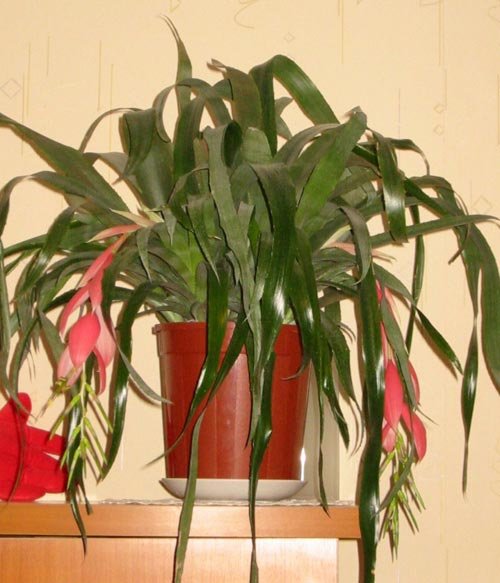
As for the plants themselves, this is mainly epiphytes. They are for the preservation of water, form a tubular sheet outlet. In plants of this genus, bilberries, leathery, hard leaves, they can be monophonic or variegated. Their form is narrow or oblong, triangular. Above, they are pointed and covered with small scales. At the edge of the leaves there are sharp thorns. The flowers are brightly colored, the petals are curled or arranged spirally. They are often collected in spike-like racemose or paniculate inflorescences. The leaves that are located with inflorescences larger than the others, they are also brightly colored. In bilberries fruits are berries. Bilberia refers to bromeliad plants, it is one of the most unpretentious plants that you can keep at home.
The plant constantly gives lateral shoots, due to which it forms large shrubs that consist of rosettes, they grow separately and reach a height of up to 60 cm. The flowering of this plant begins approximately 3 years after planting. They blossom in the first weeks of summer, and if care is good, then there is a repeated flowering, usually in April. After the flowering ends, the rosette has the property of dying off, and from the stem or root shoots grow, which blooms in the next summer. Old plants often form many outlets that look like narrow funnels, they can bloom at one time. A couple of months after the flowering period, the dead rosettes must be removed.
Bilberia: leaving.
Bilberia - the flowers are unpretentious, they are well tolerated by drafts and dry air. In winter, they easily tolerate a temperature of -3 degrees, but it is better not to allow this. Optimal for the plant will be a temperature of at least 13 degrees. The plant grows well in greenhouses and terrariums.
The plant needs light, preferably scattered, but bright. Of the direct light of the sun, bilberries, of course, must be hidden with paper or cloth. The plant will be comfortable on the windows on the east side and west. On the windowsills from the north, it will also grow quite well, but it is unlikely to blossom. In the summer it can be carried out on the street, but from rain and light it must be protected.
In the summer months, the optimum temperature for bilberries will be a temperature of up to 28 degrees. In the autumn months - at 18 degrees, but the slide should be smooth. The rest period should not be too warm in the temperature plan, there will be enough 18 degrees of heat. Winter low temperatures activate the flowering process. If in winter the plant is long in a room with a temperature of about 12 degrees, then it may get sick.
In the summer, when the temperature rises to 28 degrees, water should be poured into the leaf funnels, but we must ensure that it does not stand there very long, because the funnels can rot. At a temperature of about 20 degrees, water must be removed. If the bromeliads fade, then water can not be poured into the sockets, either. In the wild, plants also accumulate water in the rosettes, but in the rooms they have the risks of bending up several times.
In summer, the substrate is regularly moistened, but its moisture can not be tolerated, the plants do not tolerate it. All plants belonging to the genus of bromeliads, once every 10 days, must be removed from the supports (if placed on supports or pedestals) and lowered into water, which had time to settle. When the plants are saturated, they are taken out, drained of excess water and returned to the supports.
In winter and autumn, water is not poured into leaf sockets, watering the plants seldom and carefully. But this is at a temperature of about 20 degrees, if the temperature is higher, then water should be given more often, as the soil dries up. Sometimes you can pour water into the socket, but it should be warm, and keep it long there is not necessary.
Plants of this kind need a high humidity, despite the fact that the dryness of the plant is tolerated without difficulty. Leaflets should be sprayed a couple times a day. To increase the humidity, you can use a container with wet pebbles, claydite or moss. When these indoor flowers bloom, they do not need to be sprayed, because water can get to the flowers, so that stains can form, and decorativity will suffer.
When the vegetative period comes, after it is poured, the plant is usually fed once a couple of weeks. Use in this case, special fertilizers that are suitable for bromeliads. By the way, they can use fertilizers for other indoor plants, but the dose should be reduced to half. Do not forget that the nitrogen in the fertilizer should be kept less, because with its excess the plant can die.
To transplant a plant it is necessary then, when there will be a necessity. If the species is flowering, then the transplant should be performed annually after the end of the flowering period.
Substrate for transplantation should include part humus, peat land, leaf. You can add sand. For the plant, a mixture of peat, leaf earth, chopped moss, sand is suitable. You can buy special land for plants of bromeliad species in the store. For the plant not suitable for deep, but wide pots. Two to three weeks after transplanting the plant is watered a little and not often, so that it takes root. At this time, they do not need to be fed. The plant grows well on hydroponics.
Flowers bilbery propagated, mainly, offspring.
Difficulties that can arise when caring for a plant.
- On the leaves, pale brown specks may appear. The reason for this - sunburn. It is necessary to rearrange the plant so that the rays do not directly hit it.
- The tips of the leaves can turn brown. The reason is watering with hard, unsuitable water. For irrigation, you must take softer water and pour it into the "funnel".
- The plant can die. The reason for this may be overmoistening of the earth, especially this is true for plants that have not yet blossomed. If the plant has a flowering period, the dying out of the sockets is quite natural.
- The leaf socket can be loose and "fall apart". Because of this, the socket weakly holds moisture; the land can be waterlogged. The reason is little light.
- The plant can be damaged by mealybugs and scabbards.