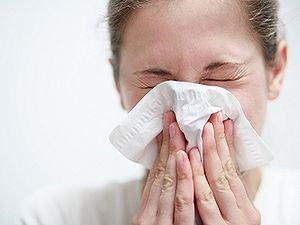
How does the allergy begin? In its development, three stages are distinguished.
Stage one - the allergen first enters the body. In the form of an allergen, anything can act: food, animal hair, pollen of flowering plants, household chemicals, cosmetics. Cells of the immune system recognize these substances as strangers, and trigger the production of antibodies. The newly formed antibodies can wait for the next contact with the allergen during the year, adhering to the so-called obese cells under the mucous membranes and epithelial tissues.
Stage two - the allergen secondarily enters the body. Antibodies respond to it, and trigger the mechanism of opening mast cells and the release of biologically active substances (serotonin, histamine and others). These are the substances that cause the main allergic symptoms (they are also called pro-inflammatory hormones or mediators of inflammation).
Stage three is the allergic reaction itself. Because of the release of biologically active substances, vasodilation begins, the penetration of tissues intensifies, edema begins, inflammations begin. In severe cases, anaphylactic shock may occur - a sharp drop in blood pressure due to a strong vasodilation.
The most acute allergosis is divided into light and heavy forms. The light forms include:
* Allergic rhinitis - swelling of the mucous membrane, because of what the nose is laid, breathing is difficult, sneezing, secretion of watery mucous secretion, burning sensation in the pharynx.
* allergic conjunctivitis - lacrimation, eyelid edema, redness, conjunctiva injection (vessels on the eye are visible), photophobia, narrowing of the eye gap.
* localized urticaria - the skin is covered with sharply outlined blisters, they have a pale center and raised edges, the appearance of severe itching.
The heavy forms of OAS include:
* Generalized urticaria - the entire surface of the skin is covered with sharply outlined blisters, and all this is accompanied by the itching of the entire body.
* Edema Quincke - swelling as skin and subcutaneous tissue, and mucous membranes. Simultaneously, edema of the joints, gastrointestinal tract and larynx can begin. With edema of the gastrointestinal tract, nausea, vomiting, and abdominal pain begin. When the laryngeal edema appears cough, choking may begin.
Anaphylactic shock - blood pressure, stuntedness (light shock) or loss of consciousness (severe shock), laryngeal edema and difficulty breathing, abdominal pain, severe itching, urticaria decrease sharply. It manifests itself within the first five minutes after contact with the allergen.
Pregnant women often suffer from hives, allergic rhinitis and Quincke's edema. Moreover, if the mother has an allergic reaction, then the allergy does not arise in the fetus (access to antibodies through the placenta is closed), but the fetus is affected by the general condition of the mother in the form of impaired blood supply to the fetus both under the influence of allergosis and under the effect of anti-allergic drugs.
The main goal of treating allergies is the effective and safe elimination of her symptoms. In the case of pregnancy - without the risks of negative effects of drugs on the development of the fetus. At the first occurring allergic reaction it is necessary to address to the allergist, even if the state of OAZ was short-lived. After all, the main and best treatment for allergic allergies is a complete lack of contact with the allergen. For its detection, a variety of studies are being conducted: the level of IgE antibodies in the blood is determined and dermal scarification tests are conducted (a solution prepared on the basis of known allergens is administered under the skin in a minimal amount and the body reacts to it on the arisen or not formed swelling around the injection ).
What actions are extremely necessary in the case of the OAS? First of all, if you know your allergen - do not allow contact with it, or eliminate its effect on you. After this, consult a doctor. If consultation is for some reason impossible, then there is a list of antiallergenic drugs.
Anti-allergenic drugs are of two generations. The first generation of H2-histaminblockers is:
Suprastin (chlorpyrramidine) - during treatment of acute allergic reactions it can be taken even by pregnant women.
Pipolphen (piperacillin) - has a high antihistaminic activity, has a sedative, hypnotic, antipsychotic, antiemetic, hypothermic effect, and is highly undesirable for use during pregnancy.
Allertec (cytiserin) - blocks the peripheral histamine H1-receptor, when applied does not cause sedation and is quite acceptable in the second and third trimester of pregnant women.
Tavegil (klemastin) - helps reduce edema, relieves pronounced itching and helps reduce vascular permeability. In the case of pregnancy, it can be used only in the case of a direct threat to the life of the patient, and there are no other drugs.
The second generation of H2-histaminoblockers is:
Claritin (loratadine) - is used to eliminate symptoms associated with allergic rhinitis and allergic conjunctivitis, in case of pregnancy it can be used only if the risk of an allergic reaction is greater than from taking the drug. But this risk is assessed solely by the doctor.
The third generation of H2-histoblockers is
Fexadine (fexofenadine) - stabilizes the membranes of mast cells and reduces the release of histamine from them, the effect of its use continues for 24 hours, does not have cardiotoxicity, sedation, does not affect psychomotor reactions, and is also contraindicated in pregnancy. Can be appointed by the doctor only in case of threat to the life of the mother.
What kind of medicines can I take with an allergy? The most important thing is not to try to treat allergy yourself, but to consult a specialist, determine the type of allergens, and try to avoid them in everyday life.