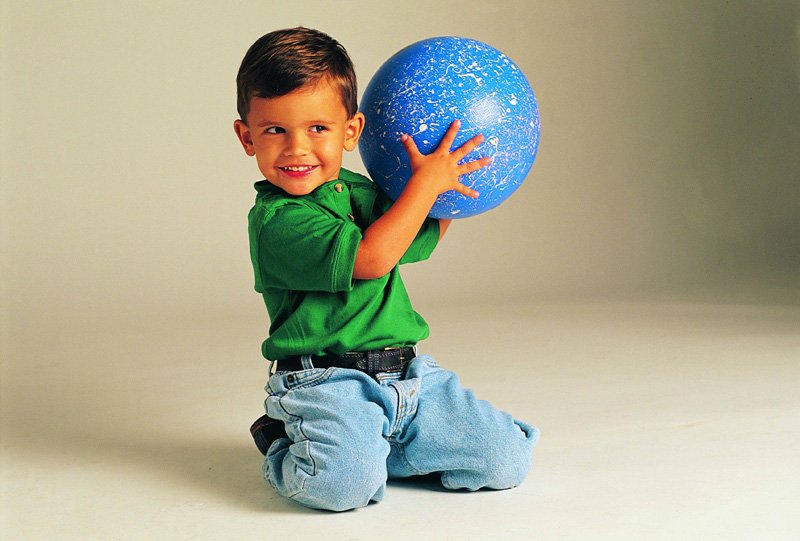
The ball is a comfortable, dynamic toy. He is present in the life of the child almost from the first months of life. All children around the world adore ball games. There are probably hundreds of such games.
Ball games play a special value for the child. They develop dexterity, coordination of movements, speed of reactions and an eye. They also affect his emotional state. The kid learns to communicate with other people through the game. He gradually understands what rules mean. And this is important for further social adaptation.
Playing with the ball, the child performs many different movements. He takes it in his hands, wears, rolls, throws, catches. Simply put, classes with the ball can be called complex. Now, all parents know that the development of hand motility, that is, various movements of the fingers and hands, is inextricably linked with the functional development of the brain and directly affects the development of speech. Therefore, playing with the ball is not just useful, but necessary for every kid.
Where to begin
At home you should have two big balls with a diameter of 15-20 cm, small balls with a diameter of 5-8 cm (tennis, rubber, rags of different materials), paper balls of crumpled paper and a large inflatable ball.
A small child is more likely to perceive an exercise than to explain it. You have to show the kid how to roll the ball, throw, catch, beat off the floor or wall.
If the child does not get it right away, do not repeatedly repeat the exercise, give a simpler task, and return to it in a few days.
Teach your child:
- toss the ball up and catch it with both hands;
- hit the ball on the floor so that it bounces as high as possible;
- Hit the ball with your foot (who will roll away further);
- throw the ball to each other and catch it;
- to hit the bowl with a ball;
- hit the ball into the box, gradually increasing the distance (with both hands and alternately with the right and left hand);
- roll the ball so that he gets between the legs of the chair (with two hands, alternately right and left hand, alternately right and left foot).
Multiple repetition of movements develops the child's sense of the ball. He begins to understand how to achieve this or that goal.
Ball games and throwing
Playing with the ball will teach your child how to handle small things skillfully: catching, carrying, rolling and folding.
As for throwing, your task is to teach the child to do it right (upwards-upwards) in the beginning, so that you do not have to wean him from the habit of throwing an object from the side or from below. For classes it is necessary to prepare paper balls and balls of different sizes. It is important for the child to learn the correct technique, that is, to take the ball with his fingers, and not "into the ladle", formed by his palm. Teach your child to throw light objects high. To do this, pull a rope over his head and ask him to throw the ball over it. Show on an example some times as correctly carried out замах for a throw. Catch the ball from the summer, children under three years are unlikely to be able to. This task is too difficult for them. It is enough that the child learns how to correctly cast an object on the range and height, and also to beat the ball off the ground.
Skating
Place the ironing board with one end on the chair, and the other on the floor. Take the two boxes. In one of them, put 3-4 small balls. Let the child roll balls from the board, and you catch them below. Show the baby how to roll them, so that the ball does not fall from the board to the floor (give acceleration). Then swap places. First, the child will catch the ball with two hands, but you gradually accustom him to catch the ball alternately with one and the other hand.
Competition of "pigeons"
To work a roll forward-up will help you paper "pigeons". Arrange a competition with your child - sweep them at a distance.
Roll rolling
A good exercise for throwing and catching the ball is rolling the ball to each other. The adult and the child sit opposite each other on the floor, legs apart and roll the ball to each other. After a while, you can roll two balls at the same time (the main thing is that the balls do not collide). The child develops the ability to concentrate, as if to catch a rolling ball and send it back to an adult.
Balls in the basket
This exercise game develops an eye, dexterity and coordination of movements when throwing the ball into a horizontal target.
Prepare any small balls. As a horizontal target, use a large basket, a high basin or a volumetric box so that the balls can stay in them after the throw.
Place the basket on the floor at a distance of 60-150 cm and mark the border beyond which you can not go. Show the child how to throw balls into the basket. First, bend over and take one ball, then lift up the ball to the shoulder, look at the basket and throw the ball with one hand. You need to throw 2-3 balls alternately with your right and left hand.
At the beginning of training, the distance to the basket should not exceed 60 cm, since children at this age often do not throw objects, but simply put them on target. Increase the distance you need gradually.
Usually, children throw objects with one hand from the shoulder. Demonstrate the baby and another way of throwing - one hand from the bottom. So the child will be easier to hit the target.
The height of the goal can be changed by placing the basket on objects of different heights.
We throw pebbles in the river
This is a very useful exercise, and if in summer you are on the shore of a water body, be sure to teach the child to throw pebbles.
But this exercise can be performed at home or during a walk. Label the coastline. Spread some cloth two or three meters from the "shore". Take 4-6 small balls (at home use paper balloons from crumpled paper as they bounce off the floor less - these are "pebbles").
Standing on the "shore", the child throws "pebbles" into the "river". He must go to the "shore", bend over, take each hand on the ball. Raise one hand up and throw the "pebble" into the river. Then repeat the same with the other hand.
To the child is not in a hurry, performing the exercise, accompany his actions with words.
When all the "pebbles" are in the "river", let the kid climb into "her" and pobarahtaetsya: on his stomach, on his back, podgigaet legs and hands, crosses from side to side. By collecting "pebbles" and returning to the "shore", you can repeat the game.
Gradually go to more complex exercises, which include elements of running, jumping and somersaults.
Grow healthy!