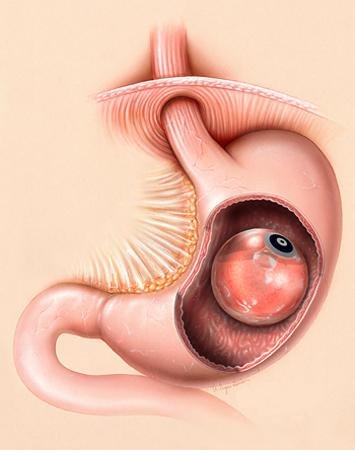
Intragastric balloon for reducing excess weight was first made in 1980. It was made by FG Gau, cooperating with IDC. The bottle is made of medical silicone high-quality rubber. 400-700 milliliters of the ball is a capacity that can vary. The procedure is that most of the patient's stomach is filled with a silicone balloon filled with water. After that, the patient can not absorb as much food as he did before. This allows you to reduce the number of calories consumed, which contributes to effective weight loss.
Effectiveness of the method
Intragastric balloon can reduce the patient's body weight from 5 to 35 kilograms. At the end of the treatment, it remains at a certain level. There are more and more willing to test this method of treatment, which has justified its effectiveness with many years of experience.
After the balloon is installed, the person's appetite decreases. This leads to a natural and gradual decrease in excess weight. It is worth noting that after taking a feeling of satiety for a long time does not leave the body. After a few months, the conditioned unconditioned reflex is fixed. A person has a different attitude to the quality and quantity of food that he uses.
The patient must take gastric acid-lowering medication omeprazole (omez) while he is being treated.
Examination before installing an intragastric balloon
You need to undergo a minimal examination before installing an intragastric balloon. Esophagogastroduodenoscopy is a procedure that is carried out first of all. With its help, all acute ulcers and erosions of the gastric mucosa in the patient are eliminated. In order to monitor the condition of carbohydrate and lipid metabolism, you need to make a biochemical blood test. It will also help to evaluate the effectiveness of the treatment after the balloon has been removed.
Indications for intragastric balloon application
At all degrees of excess weight, an intragastric balloon is prescribed. In order to determine the degree, you need to calculate the body mass index of the patient. This is the work of a specialist. It is also worth noting that if obesity is already at grade III, then a balloon for weight reduction is established in order to prepare for the forthcoming bariatric surgery. This procedure will significantly reduce the possibility of developing any complications at the time of surgery, as well as the postoperative period.
Contraindications for the use of an intragastric balloon
- The presence of erosions and ulcers of the stomach or duodenum and inflammatory diseases in the gastrointestinal tract.
- Allergic reaction to silicone.
- Breastfeeding, pregnancy, or for the near future planning of pregnancy.
- Addiction, any mental disorders or alcoholism.
- Presence of any operations on the abdominal cavity and stomach.
- Oncological diseases in the gastrointestinal tract.
- Presence of hernias in the food hole of the diaphragm, diverticula and pharyngeal structures, esophagus.
- Low discipline of the patient, because of which he can not fully comply with the prescriptions of the doctor who treats him.
- Regular intake of steroids, aspirin, anticoagulants, drugs that irritate the stomach, as well as anti-inflammatory drugs.
- The presence of possible sources of bleeding in the gastrointestinal tract: varicose veins of the stomach and esophagus, stenosis and atresia.
- The body mass index of the patient is less than 30. Except when there are diseases, the positive course of which is completely dependent on the weight reduction of the patient.
- The presence of any medical problems that complicate the performance of gastroscopy.
The process of installing the intragastric balloon
Installing a cylinder is not an operation. This is a fairly simple procedure that is performed on an outpatient basis, under gastroscopic control. The procedure can also be performed under intravenous anesthesia.
The procedure lasts from 10 to 20 minutes. At the end of the procedure, the patient needs a little rest, and then he can safely leave the clinic.
Installation of the balloon is very similar to the process of conventional gastroscopy. During the procedure, the patient can lie on his left side or back. The intragastric balloon, which is in a folded state, in a thin silicone perforated shell, under the control of the endoscope in the patient's stomach, is inserted through the mouth. In the balloon there is a catheter, with which it is filled with saline, immediately after it was in the lumen of the stomach.
The silicone tube from the cylinder valve is disconnected after it is filled and removed with the sheath through the mouth. After the end of the procedure, the specialist monitors the location of the balloon, and the patient is taken out of anesthesia.
Complications, which are possible after installation of the balloon
Gastritis, prolonged vomiting and nausea, development of ulcers - these are the most common complications arising after the installation of the balloon.
These complications can be eliminated with the help of medications. In this case, it is not necessary to remove the cylinder.
Discomfort in Egypt and increased hunger are signs that suggest that the volume of the balloon has decreased spontaneously.
Removal of the intragastric balloon
After 6 months, the balloon must be removed. Otherwise, hydrochloric acid, which your stomach produces, can destroy the walls of the balloon.
The removal of the balloon is almost the same as the installation procedure. The specialist makes perforation of the balloon with the help of a special stiletto. After this, you need to evacuate the solution and remove the silicone membrane through the mouth. The procedure takes approximately 20 minutes and is performed under anesthesia.
After that, the patient's body weight increases by an average of 2-3 kilograms. If necessary, the cylinder can be re-installed. But before this, after the first procedure should take at least one month.