Some ten years ago no one thought that the change in the seasons affected the mood of the people and the psyche. The term "seasonal depression" appeared at the end of the 20th century thanks to the doctor and scientist Norman Rosenthal, who established a connection between the reduction of daylight hours and the transition from a normal state to stress, loss of strength and efficiency, apathy and unmotivated irritation. The reason is the failure of the biological clock due to lack of sunlight.
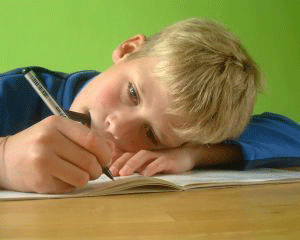
If 25 percent of the adult population of the temperate zone of the northern hemisphere is affected by seasonal or winter depression, then among schoolchildren this percentage is at least tripled. Parents and teachers usually neglect manifestations of "light deficiency" in children and adolescents, writing off behavioral problems for character deficiencies, stubbornness and disobedience, trying to correct them with more severe attitudes and punishments. However, such drugs as strap, screaming and demanding during the longest nights and short days of the year have only side effects. After all, through winter depression, the newest studies have shown, the number of exacerbations of chronic diseases increases and ... the risk of infection with viral infections increases! Even an ordinary cold can have very serious consequences.
That's when adults should arm themselves with elementary knowledge about ways to detect and neutralize this elusive enemy.
What is the manifestation of the winter depression?
First of all, in the decline in working capacity (especially in younger schoolchildren) against the background of a violation of the usual sleep mode: in the morning, it is difficult for a child to wake up, tends to sleep in the daytime, it is difficult to put it on the bed in the evening.
Secondly, in sharp mood swings. A child that is aggressively stubborn, then silent and indifferent, then without cause explodes with crying or screaming even at a cautious remark.
Third, in reducing school performance, indifference to favorite games, attachment to some kind of activity.
Fourth, in reducing appetite. On the one hand, a child eats for eating two spoons of borscht, on the other - he eats a lot of sweets. Adolescents may be attracted to alcohol.
How to get rid of it?
Light therapy! In winter, the sun is most active from 7th to 9am, so during these hours you need to be on the street as long as possible. In the school, if possible, walk (or leave the transport for several stops earlier), compulsory daily walks (in the morning or at noon) for at least half an hour. Do not hang the windows with curtains, in the evening do not save electricity - turn on as many lighting devices as possible.
Day regimen and moderate exercise. Try to go to bed and wake up at the same time (as early as possible in the evening and as early as possible in the morning) with the child. To a minimum, reduce the viewing of TV programs and the time at the computer, start doing elementary physical exercises. Even if "there is not enough time", in the morning 10-15 minutes will have to be found.
Listen to the child's body, which currently requires more carbohydrates. Do not prohibit categorically candy and chocolate, they contain the substance serotonin - a hormone of happiness that improves mood. But remember that the chemical components necessary to overcome the winter depression, there are in flour products, cereals, cheese, sour cream, butter and eggs.
Accept the child as he is without imposing excessive demands. The child and adolescent organism is simply physically unable to resist natural cycles, so it requires help and support, rather than additional psycho-emotional loads.