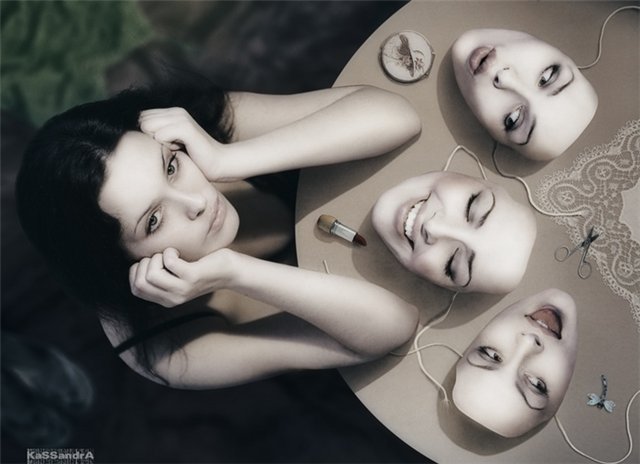
A chance meeting with a friend of youth, whom we have long since lost sight of; emergency on the road; speech to an unfamiliar audience; the long-awaited first "mom" or "dad" from the mouth of the child - a lot of events every day evoke our emotions. We are embarrassed by them, afraid to look ridiculous from the side, restrain ourselves and think that we are controlling them. And yet emotions now and again take over us.
Double standards
Perhaps the fact is that we grew up in a society where the ability to control one's feelings - "to control oneself" - was always considered a virtue. Self-control, like an alert guard, constantly reminds us: it's not right to behave too emotionally, you can not openly show your anger, you need to hide your fear, restrain excitement and even joy. Any strong emotional reaction may seem inappropriate, ridiculous, even obscene and be perceived as a manifestation of our weakness. There are not many exceptions: it is joy or anxiety experienced by many people who happened to be in certain circumstances. So, it's natural to scream together and chant slogans at a football stadium or together empathize with a television screen, on which a tsunami wave sweeps a peaceful beach. But, say, dancing in the office on the occasion of promotion, to put it mildly, is not accepted - as it is not accepted and openly experiencing their grief.
Hard self-control creates a certain psychological comfort for us: the ritualized manifestations of emotions somewhat soften the affective states (strong short-term emotional experience) and regulate it. But at the same time self-control causes frustration, creating a dangerous gap between what we feel and how we behave.
Those who have their own emotional impediments to living, sometimes try to "drown" it with the help of a miraculous pill. Many blame themselves, in their opinion, on the excessive sensitivity of their parents, who "incorrectly" raised them. But those and others do not know or forget about how important is the expression of emotions for our lives. Thanks to them, we express our true "I" and become clearer to other people. In addition, emotions are necessary for our survival. Charles Darwin first suggested that the expression of emotion has an evolutionary-biological significance *. Any animal from birth is endowed with emotions that convey information about the intentions of another being, in difficult situations, help to act instinctively without thinking. In this sense, suppressing our emotions, we literally put ourselves at risk, because each of them plays its own special role.
Fear
informs us of a real or imagined danger. He catches what is significant for our life at the moment. Fear not only takes information, but also gives the body the commands: it directs the blood to the legs, if it is necessary to run, or to the head, if necessary to think. As a rule, fear mobilizes our energy, although sometimes its effect turns out to be the opposite: it paralyzes us while we decide how to proceed in a particular situation.
Anger
sometimes confused with violence, which he can provoke. Typically, this feeling covers a person when he suspects that he is not taken seriously (and some people are constantly living with this feeling). But anger can be and is useful: it causes the release of hormones into the blood (including adrenaline), and they, in turn, provide a powerful splash of energy. And then we feel our strength, we feel courage and self-confidence. In addition, anger tells us that we have come to a point beyond which we can stop controlling ourselves - in a sense, it replaces the manifestation of violence.
Grief
helps to escape to experience the loss (a close person, some qualities in oneself, material objects ...) and return the energy of life. It allows you to "overcome yourself", adapt to the loss and again find the lost meaning of what is happening. In addition, the experience of grief causes sympathy and attention of other people - and we feel more protected.
Joy
the most desired emotion. It is she who releases the maximum amount of energy, stimulating the release of pleasure hormones. We feel confident, our own importance, freedom, we feel that we are loved and loved. Joy acts as a magnet: attracts others to us and helps us share our feelings. It is also known that a smile and laughter have a curative effect, enhancing the immune defense of the body.
Mind and feelings
Another important advantage of emotions is that they make us smarter. For a long time, science in some sense depreciated them, placed below the thinking mind. After all, from the point of view of evolution, emotions were born in the depths of the "prehuman" archaic mind and are closely related to the instinctive behavior of animals. New departments of the cerebral cortex, which, in particular, are responsible for the processes of conscious thinking, appeared much later. But today it is known that in its pure form the mind does not exist - it is nourished by emotions. The American neurologist Antonio Damasio proved that knowledge, which is not accompanied by emotions, turns out to be sterile, and an emotionally cold person is not able, for example, to learn from his mistakes. It is interesting that children and adults learn and remember something new only against the background of a positive and sufficient strong emotional impulse, which, figuratively speaking, opens the door to a new area of neural connections.
Perception also does not exist without emotions. Every word, every gesture, smell, taste, image perceived by us is immediately "interpreted" by our feelings. Without emotions, we would turn into machines and dragged a rather colorless existence.
Psychologist Daniel Goleman (Daniel Goleman) introduced the scientific concept of "emotional intelligence." He came to the conclusion that our personal success depends not so much on IQ, the index of intellectual development, as on the emotional coefficient (EQ). Based on the data of experiments, he proved that in the professional environment the most successful are not specialists with a variety of diplomas, but those who possess valuable human qualities - the ability to analyze their feelings and manage their own and others' emotions. When such people, for example, are asked to help them solve a problem, then others readily respond, while "emotional disabled" (with low EQ) can wait a few days for an answer to their request ...
Voice of the unconscious
Emotions tell us the most important information about ourselves or about what we are dealing with, and therefore they should be trusted, listen to them and rely on them. At first glance it seems that such an existential position contradicts the personal experience of many of us: more than once we were wrong, walking on the occasion of feelings. The largest German philosopher Max Scheler (Max Scheler) explained this contradiction by the existence of two types of feelings. On the one hand, there are contact feelings, acting like a mechanism of touch. When we feel joy, we feel better, we can relax, we are less anxious, which means that we are able to experience "more life". If something upsets or angers us, we almost physically feel that we are deprived of health, energy - "part of life." Contact feelings convey important information about the existential significance of what is happening for my health, my vitality. But such feelings (often coming from childhood) should not be relied on in decision-making, it is important to be able to remove them, put them in brackets.
But there is another kind of feeling - distant emotions. They do not have a direct relationship to our current state, but they catch something very significant about the other person. This is an intuitive feeling known to everyone. This is what prompts us to ask a loved one: "Did something happen to you?" Or orders: "We must call home urgently!" They do not teach us to listen to distant feelings, but they allow us to instantly assess the atmosphere in a group of people, interlocutor or situation. If you turn back on your life, you will probably notice that all the most important and correct decisions in it have been made, relying on a flair: rational explanations usually come later.
Trust in your emotions can and should be educated, trained. It is important only not to confuse the contact feelings that communicate about us in person, with distant people talking about another person.
High Voltage
When the strength of the experiences is too great, we have mechanisms of psychological protection included - and we do not feel anything else. Depression, apathy, stupor - so it looks from the outside, and from the inside the person just does not hurt anymore, as with anesthesia. Suppressed ("forgotten") emotions we transform into bodily sensations, erasing the relationship between emotional experience and what caused it.
Sometimes emotions take the form of their opposite. Sadness is sometimes expressed in euphoric excitement; joy - in tears; sometimes we can burst out laughing loudly - if only despair does not crush us. The mechanisms of psychological defense deplete our mental and physical forces and almost always turn out to be ineffective: at some point the true feelings break through and overwhelm us. Those who successfully hide their emotions, too, are subject to their pressure. You can picture laughter, play anger, lie about your true feelings, but you can not always pretend forever: sooner or later they will come out. So it is better to be able to take them as they are.
Exercises for the senses
You are quick-tempered or hypersensitive, notorious, or paralyzed by fear ... Try to master a few simple exercises that will help to harmonize your emotions.
You are not integrated
You hold back, not allowing yourself to express neither anger nor joy ... Your behavior has a motive that it is not easy to recognize. The way out is to "let go" yourself, to release your feelings.
1. Try to express feelings by gestures.
Words are important, but 90% of our emotions are expressed by facial expressions, body. Smile, pose, gestures - even a simple shrug of the shoulders speaks of our attitude to what is happening more than long speeches ...
2. Recognize the existence of emotions.
If a child is afraid of wolves, it is useless to convince him that in our forests they are not found. Accepting his feelings, parents can ask: "What can I do to calm you?" To be afraid is not a shame, one should not be ashamed of fears. None of our emotions are dangerous, they are our allies, from which we should not constantly wait for a dirty trick.
3. Keep a diary.
It's like sharing your feelings with a friend. Such a written story helps to remember forgotten emotions, think about them, develop an attitude towards them.
You are paralyzed by fear
The higher the "stakes" (that is, the bigger the loss in defeat and the greater the reward for winning), the more you panic. You are so afraid of failure that you are mentally drawing the most disastrous scenarios and your hands are falling. The way out is to master your feelings and overcome the "paralysis" of the will.
1. Look for a situation in the past that pops up in your mind at the moment of panic.
To whom is he who looks like fear to you? Maybe the teacher who tortured you in childhood, or a neighbor who did not give you a pass? Each stressful situation evokes in us a memory of the one we experienced in the past, often in the first six years of life. And again the feeling of fear that we could not overcome comes back to us.
2. Breathe properly.
Concentrate your attention on your breathing: extend the exhalations and shorten the breaths to neutralize your inner sensations.
3. Remember your successes.
On how, for example, how brilliantly you passed the exam or won a friend a tennis set. Based on past successes and associated feelings of pleasure, you can overcome the desire to see catastrophic scenarios of unreached events.
4. Prepare for the test.
Consider the possible variants of the event, determine what you want to achieve in any case, and what you can give ... This will help you better control your emotions.
5. Look at the interlocutor, but not directly in the eyes, but in the point between them.
You can focus on what you say, and not on what you read in his eyes ...
You are hot-tempered
The way out is to learn to own your feelings and manage the conflict situation.
1. Do not accumulate claims.
The more you store them in yourself, the more you risk losing. Speaking of your claims, you help yourself avoid the outbreak of unbridled anger.
2. Learn to express your feelings clearly.
Name the feeling that bothers you. Without complaining or blaming, say openly: "I have problems at work, I'm screwed up and do not know what to do."
3. Pause.
The brain needs time to make a decision and take control of the situation. Relax the solar plexus: take a deep breath, hold your breath for a few seconds, exhale and wait before you breathe again. From time to time, close your eyes for 2-3 seconds: turning off the visual signals reduces the voltage.
4. Method "X, Y, Z".
American psychotherapist Haim Ginott advises to build his statements on the scheme: "When you did (X), I felt (a) Y, and at that time I wanted you to do (a) Z." For example: "When you reproached me for being late, I felt guilty. You'd better hug me instead of scolding me. "
5. Hold out your helping hand.
Before responding aggression to aggression, ask the "aggressor": "Do you have something wrong?" Or offer him a truce: "I'm starting to get nervous, let's pause, cool down".
You are hypersensitive
You equally emotionally react and to critical remarks, and to compliments. The way out is to establish a balanced relationship with people.
1. Do not get hung up on yourself.
You are unnecessarily worried about what others think about you. Try to "depart" a little from yourself and show empathy (empathy). Learn to put yourself in the shoes of another person. What is he thinking about? What's going through? Such a change in the angle of view helps to change the relationship strategy.
2. Do not strive for everyone to love you.
Sometimes you should take a chance and agree that someone will not like your actions, but someone will complicate life. It is impossible to avoid manifestations of rivalry, antipathy, incompatibility of characters. The clearer you become aware of this, the easier it will be for you to accept it, and the other will find it harder to deceive you.
3. Try to find "trigger" situations.
Make a list of situations in which you are particularly vulnerable, and words that provoke your inadequate behavior. Faced with them again, you can learn them and not get lost.
4. Avoid categorical forecasts.
To appeal to myself in an orderly ("I must make a career!") Or a minor tone ("I am sure I will live all my life one (for) ...") you do not benefit: you feel the burden of guilt for your troubles, and this weakens your vitality and does not give the tune to victory.